Overview
In 2014, two entrepreneurs in their early 30s ventured into the education space with their startup.
Both founders were engineers who had previously worked in the IT sector. Their unique idea was to educate people in a fun and engaging way.
Over time, the company became a leader in the edutainment sector. Corporates started using their services for employee engagement and training programs. The company also used these tools for brand activations targeting young audiences.
The business operated through events conducted by their internal operations team and through a franchise model across different regions.
As the company expanded, the business developed three major verticals:
- Edutainment programs in schools
- Corporate training and engagement programs
- Social party entertainment experiences
Within four years, the company grew its business four times.
The Challenges
Despite rapid growth, the client began facing cash flow problems. Even though the business was expanding and revenue was increasing, they frequently experienced cash shortages when payments needed to be made.
The management team regularly tracked:
- Bank balances
- Receivables from clients
- Payments due during specific periods
However, they could not understand why profits were not improving.
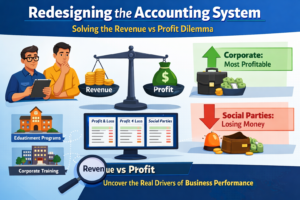
The company maintained a single accounting system for all three business verticals. This created a vague picture of expenditures and revenue streams. As a result, it became difficult to understand which verticals were profitable and which were affecting the company’s finances.
Our Solution
The client approached CFO Services to identify the root cause of the issue. After a series of
question-and-answer sessions about each vertical, the CFO Services team identified the problem.
The recommendation was to maintain separate accounting structures for each business vertical.
Initially, the client believed this would be difficult because the operations of all three verticals
were interconnected. However, after discussion, they agreed to implement the solution.
Key steps implemented:
- Design a new accounting system capable of capturing financial data separately for each vertical (schools, corporates, and social parties).
- Track financial performance based on time periods and event data.
- Generate detailed profit-and-loss reports showing performance of each vertical.
Results
- After several months of data tracking, CFO Services presented detailed financial reports.
- The company gained complete visibility into the performance of each business vertical.
- The ‘Social Parties’ vertical, which consumed the most time and resources, was actually generating losses.
- The ‘Corporate’ vertical, which received less marketing focus, turned out to be the most profitable segment.
Key Insight
Revenue is good, but profits are better. Detailed financial analysis helps uncover the real drivers of business performance.