
India has seen a transformative shift in the way businesses operate, particularly after the implementation of the Companies Act, 2013, which made Corporate Social Responsibility (CSR) spending mandatory for certain companies. This legal push, combined with growing public awareness, has made CSR a central part of corporate strategy in India.
Under Section 135 of the Act, companies with a net worth of ₹500 crore or more, or a turnover of ₹1,000 crore or more, or a net profit of ₹5 crore or more, are required to spend at least 2% of their average net profits of the previous three years on CSR activities.
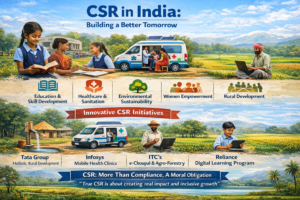
Key Focus Areas of CSR in India
- Education and Skill Development
- Healthcare and Sanitation
- Environmental Sustainability
- Women Empowerment
- Rural Development
Innovative CSR Initiatives in India
1. Tata Group – Holistic Rural Development
The Tata Group has long been a pioneer in CSR. Through the Tata Trusts and individual company initiatives like those of Tata Steel and TCS, they focus on:
- Education (Tata STRIVE for skill development)
- Water management and sanitation
- Tribal development programs in Jharkhand and Odisha
- Microfinance for women in rural areas
Tata’s commitment to community development often exceeds the mandated 2% spending, showing deep-rooted ethical business practices.
2. Infosys Foundation – Innovation in Education and Healthcare
The Infosys Foundation, led by Sudha Murty, supports:
- Construction of libraries and laboratories in government schools
- Rural healthcare infrastructure
- Arts and culture preservation
One innovative project was setting up mobile health clinics in remote villages using technology and solar-powered medical units.
3. ITC – Triple Bottom Line Approach
ITC’s CSR is integrated into its business model. Key projects include:
- e-Choupal: A digital initiative connecting over 4 million farmers to market data, weather forecasts, and agri-services, reducing middlemen and increasing farmer income.
- Sustainable Paper Manufacturing: Using agro-forestry with local farmers to grow pulpwood, creating rural employment while ensuring a renewable supply chain.
This blend of business and social impact has made ITC a model for inclusive growth.
4. Reliance Foundation – Bharat India Jodo
The Reliance Foundation has worked extensively in:
- Rural transformation
- Disaster response (e.g., during floods and COVID-19)
- Promotion of sports, including the Young Champs football academy
One standout initiative is the Reliance Foundation Digital Learning Program, which provided e-learning resources to rural schools and colleges, especially during the pandemic.
5. Mahindra Group – Nanhi Kali and Project Hunnar
Mahindra’s flagship CSR projects include:
- Project Nanhi Kali: Supporting over 500,000 underprivileged girls with education, uniforms, and study materials.
- Project Hunnar: A vocational training program aimed at enhancing employability among youth in smaller towns.
These initiatives target social equity and gender empowerment, a pressing issue in India’s development journey.
CSR and Innovation in Indian Startups
CSR isn’t limited to legacy companies. Startups and new-age companies are also making waves:
- Zomato Feeding India: A not-for-profit initiative tackling hunger by redistributing surplus food from restaurants to the needy.
- BYJU’S Education for All: Donating digital learning content to underserved children in remote areas.
Challenges and the Way Forward
While CSR in India has made significant strides, some challenges persist:
- Lack of impact measurement and transparency
- Regional imbalance in CSR spending (mostly concentrated in urban areas)
- Limited community involvement in project planning
To improve, companies need to:
- Integrate CSR into core strategy
- Co-create projects with local stakeholders
Use technology for better tracking and outcomes.
Interesting Facts About Corporate Social Responsibility (CSR)
- India is the first country in the world to mandate CSR by law
With the Companies Act, 2013, India became the first nation to legally require certain companies to spend on CSR. This has driven billions of rupees annually into social development projects. - Over ₹25,000 crore spent on CSR in India in recent years
Indian companies have collectively spent over ₹25,000 crore in sectors such as education, health, rural development, and disaster relief since CSR was made mandatory. - Top sectors receiving CSR funds
Education, healthcare, rural development, and environmental sustainability are the most funded CSR categories in India. - CSR spending is more than just charity
Many businesses are now adopting strategic CSR, where their initiatives align with long-term business goals—such as skill development creating a future workforce. - Employee engagement in CSR is rising
Companies are increasingly involving their employees in CSR activities, from volunteering to skill-sharing, fostering a stronger corporate culture and team morale. - CSR boosts brand loyalty and reputation
According to global surveys, 78% of consumers are more likely to buy from companies that actively support social or environmental causes.
CSR: More Than a Mandate, a Moral Obligation
While the Companies Act, 2013, has institutionalized CSR, it’s important to remember:
“CSR should not merely be an act of compliance; it should stem from a company’s values and sense of responsibility toward society.”
True CSR is not about ticking checkboxes or allocating budgets. It is about:
- Acting with integrity
- Creating inclusive growth
- Addressing real social needs
- Building trust and goodwill
When companies embrace CSR in spirit, not just in letter, it reflects a culture of ethical leadership and long-term vision. The most impactful CSR efforts are those that:
- Involve the community in decision-making
- Are rooted in empathy and awareness
- Aim for sustained change, not just short-term visibility