
Once a foreign companies in India completes incorporation, most founders assume the hard part is over.
Legally, the company now exists, the Certificate of Incorporation has been issued and the entity is registered with the Ministry of Corporate Affairs.
However, in practical terms, the business is not yet ready to operate.
Before a company can receive payments, hire employees, or start commercial activity, a few critical elements must be in place, tax registrations, a functioning bank account, and key post-incorporation compliances. These steps collectively enable the company to operate both financially and legally in India.
PAN is the Company’s primary tax identity
PAN (Permanent Account Number) is the Company’s core tax identification number, and almost all financial transactions are linked to it.
Under the current incorporation system, PAN is typically allotted along with the Company’s registration through the integrated filing process. This has eliminated the need for a separate application after incorporation.
Despite this integration, PAN remains essential. It is required for opening bank accounts, filing income tax returns, and undertaking most financial and regulatory transactions in India.
TAN becomes relevant as operations begin
TAN (Tax Deduction and Collection Account Number) is also generally allotted as part of the incorporation process.
It becomes relevant once the company starts making payments that require tax deduction at source, such as salaries, professional fees, or contractor payments.
Whenever such deductions are made, the company must report them to the authorities, and TAN is the number through which these filings are tracked.
Unlike earlier processes where separate applications were required, PAN and TAN are now integrated with incorporation, making the overall setup process more efficient and predictable.
The bank account makes the Company operational
Even with incorporation, PAN, and TAN in place, a company requires a bank account to function in practice.
This is the stage where the entity begins to operate like a real business, receiving client payments, making vendor payments, and managing operational expenses.
Opening a bank account typically requires incorporation documents, PAN details, and identity verification of directors.
In cases involving foreign shareholders or directors, banks usually conduct additional compliance checks, including verification of ownership structure and regulatory requirements. This is standard practice and may extend timelines.
In many cases, banks may also expect at least one authorized signatory to be available in India for documentation or verification purposes. Planning for this in advance helps avoid delays.
Commencement of Business (INC-20A)
One important compliance that is often overlooked is the filing of the commencement of business declaration in Form INC-20A.
This filing is mandatory for companies having share capital and must be completed within 180 days of incorporation. The company is required to confirm that the initial share capital has been received in its bank account.
Until this form is filed, the company is not permitted to commence business activities or exercise borrowing powers.
For foreign-owned companies, this step is closely linked to opening the bank account and receiving the initial investment, making it a key milestone in the setup process.
GST and other registrations
Depending on the nature of business, companies may also need to evaluate registration under Goods and Services Tax (GST).
If the company is engaged in the supply of goods or services in India, GST registration may be required either from the outset or once prescribed turnover thresholds are crossed. In certain cases, particularly for service-oriented or cross-border businesses, registration may be required earlier than expected.
FEMA and foreign investment compliance
For foreign-owned companies, the initial capital infusion into India must comply with foreign exchange regulations under FEMA.
This includes reporting requirements such as filing Form FC-GPR after receipt of share capital. Banks closely monitor these transactions to ensure compliance, which makes accurate documentation and timely filings essential.
Where foreign founders typically face delays
The process itself is not particularly complex on paper. However, delays often arise due to practical issues.
Documents may not match bank expectations, identification may require additional verification, or clarifications may be sought regarding ownership structure.
Individually, these are minor issues, but they can extend timelines if not addressed early.
This is why many foreign entrepreneurs choose to complete these steps alongside incorporation rather than treating them as separate processes.
How it fits into the overall setup process
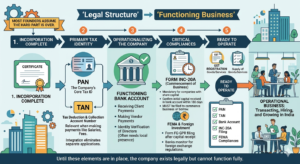
It helps to view the company setup process in phases:
- Incorporation creates the legal entity
- PAN and TAN establish its tax identity
- The bank account enables financial transactions
- Filing INC-20A formally activates the company for business operations
Until all these elements are in place, the company exists legally but cannot function fully.
What most founders realise afterwards
For many foreign companies in India entering, the process turns out to be more structured than expected.
The system is largely digital, tax registrations are integrated with incorporation, and banks are increasingly familiar with foreign-owned entities.
Once PAN, TAN, the bank account, and commencement compliance are in place, the company transitions from a registered entity to an operational business, ready to transact, hire, and grow in the Indian market.
Frequently Asked Questions for Foreign Companies in India
What should foreign companies in India do after incorporation?
After incorporation, foreign companies in India must complete PAN, TAN, open a bank account, file INC-20A, and ensure GST and FEMA compliance before starting operations.
Is PAN and TAN mandatory for foreign companies in India?
Yes, PAN is essential for all tax and financial transactions, while TAN is required when foreign companies in India deduct TDS on salaries, payments, or contracts.
Can foreign companies open a bank account in India easily?
Foreign companies in India can open a bank account, but banks may require additional verification, KYC checks, and an Indian authorized signatory, which can cause delays.
What is INC-20A and why is it important in India?
INC-20A is a mandatory filing that confirms receipt of share capital. Without it, foreign companies in India cannot legally start business operations or borrow funds.
Do foreign companies in India need GST registration immediately?
Not always. Foreign companies in India must register for GST based on business activity and turnover, but in some cases, early registration is required.