

When founders hear the term outsourced accounting services, the first reaction is usually practical.
“Okay. But what exactly are we giving out?”
There is always hesitation around finance. It involves money, compliance, vendor payments, sensitive data. Handing it outside feels risky unless you understand what is actually being outsourced.
The truth is, most accounting functions can be outsourced safely, provided structure, access control, and reporting systems are in place.
But not every decision should be outsourced.
Let’s break this down clearly.
First, Understand the Difference Between Execution and Control
Before listing functions, we need to clarify something important.
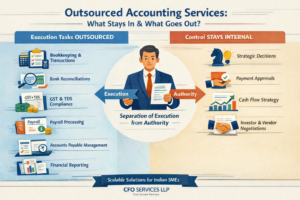
Outsourcing accounting services does not mean outsourcing financial control.
Execution can move outside.
Authority should remain with the founder or promoter.
For example, transaction recording can be outsourced. Approval of payments should remain internal.
Preparation of financial reports can be outsourced. Strategic financial decisions should remain internal.
When this distinction is clear, outsourcing becomes far less intimidating.
- Bookkeeping and Transaction Recording
This is the most commonly outsourced function and it is completely safe when managed properly.
Daily recording of:
- Sales invoices
- Purchase bills
- Expense entries
- Journal adjustments
- Bank transactions
These are process-driven tasks. They require accuracy and consistency, not strategic judgment.
Professional outsourced accounting services handle transaction recording with defined timelines and review mechanisms. When reconciliations are built into the workflow, bookkeeping becomes structured instead of reactive.
There is very little strategic risk in outsourcing this function. In fact, accuracy often improves because review layers are added.
- Bank and Credit Card Reconciliations
Reconciliation is one of the most neglected areas in SMEs.
When banks are not reconciled monthly, errors accumulate quietly. Duplicate entries, missed transactions, incorrect balances all distort financial clarity.
Reconciliations are highly process oriented. They can be outsourced safely under structured oversight.
What should remain internal? Final review of significant mismatches or unusual transactions.
The work can move outside. The awareness should remain inside.
- GST and TDS Compliance
This is where founders get cautious.
Can compliance be outsourced safely?
Yes, but with layered review.
Preparation of GST returns, reconciliation of purchase registers, matching GSTR-2B data, TDS calculations, deposit tracking, all of these fall well within structured outsourced accounting services.
What should not be outsourced blindly is the final understanding of tax impact. The business owner should still review summary liability reports before filing.
Execution can be outsourced. Responsibility cannot.
When handled properly, outsourcing compliance actually reduces exposure because reconciliation happens before filing, not after notices.
- Payroll Accounting Entries
Payroll processing and payroll accounting are separate things.
Payroll calculation may be managed by HR or payroll software, but accounting entries related to salary, deductions, PF, ESI, and TDS can be outsourced safely.
These entries follow defined rules. They require consistency more than judgment.
The sensitive data risk can be managed through role-based access controls.
- Accounts Payable Management (With Controls)
Vendor bill recording and payable ageing tracking are safe to outsource.
Vendor payment execution, however, should remain controlled internally.
A structured outsourcing setup usually works like this:
- Bills are recorded externally
- Payable ageing reports are generated
- Internal management reviews dues
- Final payment approvals remain internal
This ensures discipline without losing control.
Many SMEs struggle here because vendor payments become relationship-driven rather than system-driven. Outsourced accounting services introduce transparency into who is owed what and when.
- Accounts Receivable Tracking
Tracking receivables is operational, not strategic.
Generating ageing reports, highlighting overdue customers, reconciling collections against invoices, all of this can be outsourced safely.
In fact, outsourced tracking often improves follow-ups because data becomes consistent.
The decision to escalate collections or renegotiate terms remains internal.
- Preparation of Financial Statements
Monthly preparation of:
- Profit and loss statements
- Balance sheets
- Cash flow summaries
- Management reports
This is core to structured accounts and finance services.
The preparation can absolutely be outsourced. Review and interpretation should remain with management.
Think of it this way: the outsourced team builds the dashboard. The founder drives the car.
- Audit Coordination and Documentation
Audit stress usually comes from poor documentation.
Outsourced accounting services can prepare schedules, ledger summaries, reconciliation statements, and working papers well in advance of audits.
This reduces last-minute chaos.
However, strategic discussions with auditors , especially around significant adjustments or business-specific judgments, should involve management directly.
- Fixed Asset Registers and Depreciation Tracking
Maintaining asset registers and calculating depreciation are structured tasks governed by accounting standards.
They can be outsourced safely with periodic internal review.
These functions are formula-driven and documentation-heavy, making them suitable for structured external handling.
What Should Not Be Fully Outsourced?
It is equally important to understand what should stay internal.
Strategic Financial Decisions
Capital allocation, pricing strategy, cost restructuring, funding discussions — these require business judgment and cannot be outsourced.
Final Payment Authorisations
While payable tracking can be outsourced, actual bank payment approvals must remain within internal control.
Cash Flow Strategy
Preparation of cash flow reports can be outsourced. Deciding how to manage working capital gaps cannot.
Sensitive Negotiations
Discussions with investors, lenders, or major vendors should remain founder-led, even if backed by outsourced financial data.
The Real Safety Factor: Structure
Safety in outsourced accounting services does not depend on geography. It depends on process.
Key safeguards include:
- Role-based system access
- Documented approval workflows
- Internal review layers within the outsourced team
- Defined reporting cadence
- Segregation between data entry and payment execution
When these are in place, outsourcing becomes safer than many informal internal setups.
The biggest risk in SMEs is not outsourcing. It is lack of structure.
Why Many Founders Delay Outsourcing
There is a belief that outsourcing means losing grip.
In reality, many founders already lack visibility but assume control because the function is in-house.
True control comes from:
- Timely reports
- Clean reconciliations
- Documented processes
- Predictable compliance
If outsourcing strengthens these, control increases.
When Is It the Right Time?
If your accounting workload has grown beyond what one person can comfortably manage, it is time to evaluate outsourcing.
If month-end closure stretches beyond two weeks consistently, it is a signal.
If audit adjustments are frequent and documentation feels weak, structure is needed.
Outsourcing accounting services at the right stage prevents operational drag later.
Final Perspective
Most operational accounting functions can be outsourced safely, bookkeeping, reconciliations, compliance preparation, reporting, documentation, and ledger management.
What should remain internal is decision-making authority, payment approvals, and strategic oversight.
Outsourcing accounting services is not about surrendering control. It is about separating execution from authority.
For growing Indian SMEs, structured accounts and finance services provide scalability without building an entire finance department internally.
When process strengthens and visibility improves, outsourcing stops feeling risky.
It starts feeling logical.
Frequently Asked Questions: Outsourced Accounting Services
- Which accounting functions are most commonly handled under outsourced accounting services?
Most outsourced accounting services handle bookkeeping, bank reconciliations, GST and TDS preparation, payroll accounting entries, accounts payable and receivable tracking, and preparation of monthly financial statements. These are execution-heavy, process-driven functions that can be managed safely with defined controls.
- Can outsourced accounting services handle GST compliance in India?
Yes. GST return preparation, reconciliation of purchase registers with GSTR-2B, tax liability calculation, and filing support are commonly included in outsourced accounting services. However, business owners should still review summary reports before final submission to maintain oversight.
- Is it safe to outsource accounts payable management?
Recording vendor bills and generating payable ageing reports can be outsourced safely. Final payment approvals and bank transaction authorisations should remain under internal control. A well-structured outsourcing accounting services model separates execution from authorisation.
- Do outsourced accounting services include financial reporting?
Yes. Preparation of monthly profit and loss statements, balance sheets, cash flow summaries, and management reports is typically part of structured accounts and finance services. Interpretation of those reports and strategic decisions should remain with business leadership.
- What accounting functions should not be outsourced?
Strategic financial planning, capital allocation decisions, pricing strategy, and final bank payment approvals should not be fully outsourced. Outsourced accounting services manage execution, while strategic control should remain with the promoter or management team.
- Are outsourced accounting services suitable for mid-sized Indian SMEs?
Mid-sized SMEs often benefit the most. As transaction volume increases, compliance complexity grows. Outsourcing accounting services provides structure and review layers without requiring the business to build a full internal finance department.