
There’s a stage in every growing SME where finance quietly becomes the bottleneck.
It doesn’t happen dramatically. There’s no crisis at first. Sales are growing. Operations are moving. Customers are coming in.
But month-end starts stretching.
Books close late. Receivables aren’t fully clear. GST numbers feel approximate. Audit preparation becomes stressful. The founder starts asking sharper questions and the answers become slower.
This is usually when the conversation around outsourcing accounting services begins.
Not because the founder wants to cut costs.
Because they are tired of operating without clarity.
Let’s talk honestly about what this means in the Indian SME context.
What Outsourcing Accounting Services Actually Means
Outsourcing accounting services means shifting from a person-dependent finance setup to a process-driven one handled by a structured external team.
In many SMEs, accounting lives with one trusted individual. That person handles bookkeeping, GST, TDS, vendor payments, payroll entries, and audit coordination. Over time, knowledge becomes concentrated. Systems become informal. Controls become verbal.
It works until scale exposes the cracks.
Proper outsourced accounting services are not about moving data entry outside. They are about introducing structure:
- Defined month-end closure timelines
- Regular bank reconciliations
- Accurate GST and TDS tracking
- Clear receivable and payable ageing
- Consistent financial statements
- Audit-ready documentation
The goal is simple: numbers that can be trusted.
The Reality of Running Accounts in India
Accounting in India is layered with compliance.
GST reconciliations require alignment between books and returns. TDS deductions must match payments and filings. ROC filings have deadlines. Audit documentation must be clean. Vendor mismatches create cascading complications.
When systems are loose, small errors accumulate quietly.
Most founders underestimate the cost of messy accounting. It is not just about penalties. It is about distraction. Every notice, every mismatch, every last-minute reconciliation eats management time.
And management time is the most expensive resource in any SME.
Structured outsourced accounting services reduce that noise by making compliance predictable instead of reactive.
Why In-House Accounting Breaks After a Point
There is nothing wrong with in-house accounting. In fact, for early-stage businesses, it is practical.
But growth changes the equation.
At low turnover, one accountant can manage entries and compliance.
As turnover grows, transaction volume multiplies. Vendor networks expand. Customer credit cycles become more complex. Payroll grows. Audit scrutiny increases.
Now the same accountant must juggle:
- Daily bookkeeping
- GST filing
- TDS reconciliation
- Vendor follow-ups
- Payroll entries
- Financial reporting
- Audit coordination
Even capable professionals get stretched. Reporting gets delayed. Reviews become superficial. Founder visibility reduces.
The risk is not incompetence. The risk is overload.
Outsourcing does not replace effort. It replaces overload with structure.
How Outsourcing Accounting Services Works in Practice
A proper transition is methodical.
Step 1: Assess the Current State
Before anything changes, the existing books are reviewed in detail.
Bank reconciliations are examined. Vendor ledgers are checked. GST returns are compared against accounting records. Compliance history is reviewed.
This stage often reveals gaps that were never fully visible. Old balances, incomplete reconciliations, mismatched entries.
It can be uncomfortable. But clarity is necessary before improvement.
Step 2: Clean-Up and Stabilisation
There is no point layering structure over confusion.
Historical mismatches are corrected. Pending reconciliations are completed. Compliance backlogs are addressed. Documentation is organised.
Only after stabilisation does ongoing outsourcing begin.
Step 3: Process Definition
This is where transformation really happens.
Instead of informal handling, defined workflows are introduced:
Invoices must be recorded within fixed timelines. Payment approvals follow documented hierarchies. Expense submissions require structured documentation. Month-end closure has a fixed schedule.
Accounting stops being reactive.
Step 4: Ongoing Accounting Operations
Once the foundation is set, day-to-day activities shift to the outsourced team.
Transactions are recorded regularly. Banks are reconciled systematically. Compliance filings are prepared in advance of deadlines. Financial statements are generated monthly, not quarterly.
The founder is not removed from the process. Visibility increases through reporting cadence.
What Comprehensive Accounts and Finance Services Include
Good accounts and finance services go beyond bookkeeping.
They include accurate classification of income and expenses so that margins are meaningful. They ensure that receivables are tracked and overdue customers are visible. They monitor payables to prevent unnecessary penalties or strained vendor relationships.
They prepare monthly profit and loss statements and balance sheets that reflect actual business performance, not approximations.
They coordinate with auditors proactively instead of scrambling during year-end.
They build basic internal controls that reduce the risk of financial leakage.
Most importantly, they make financial information usable.
The Difference Between Compliance and Control
Many SMEs believe they are “handling accounts” because returns are being filed.
Compliance is necessary, but it is not control.
Control means:
You know your cash position precisely.
You know which customers are overdue.
You know your gross margin by month.
You know your expense ratios.
When accounting is weak, these answers are estimated. When accounting is structured, they are measured.
That difference directly affects strategic decisions.
Is Outsourcing Accounting Safe?
Concerns around confidentiality and control are valid.
However, informal internal setups often create more risk than structured outsourcing.
When one person has access to everything without review layers, risk increases. When documentation is scattered and approvals are verbal, accountability weakens.
Professional outsourced accounting services implement role-based access, documented approvals, defined segregation of duties, and internal review mechanisms.
Control becomes visible rather than assumed.
Who Should Seriously Consider Outsourcing Accounting Services?
SMEs that are scaling beyond their early informal stage should evaluate outsourcing carefully.
If your turnover is growing steadily and you find it difficult to close books on time, outsourcing deserves attention.
If compliance deadlines create stress each quarter, outsourcing may bring stability.
If you are preparing for funding, expansion, or professionalising your business, structured accounting becomes essential.
Outsourcing is not for businesses unwilling to adopt process discipline. It requires transparency and willingness to formalise systems.
What Changes After Finance Becomes Structured
The change is not dramatic at first.
Books start closing on time.
Reports arrive consistently.
Cash visibility improves.
Audit discussions become straightforward instead of defensive.
Over time, decision-making improves.
When financial data is reliable, founders negotiate better. They plan better. They allocate capital more confidently.
The biggest shift is psychological. Anxiety reduces because uncertainty reduces.
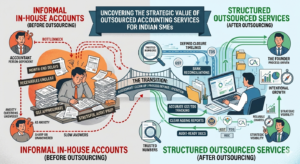
Best Outsourcing Accounting Services in India
Choosing the Right Outsourced Accounting Partner in India
Selection should be thoughtful.
Ask how transition will be handled. Ask what reports will be delivered monthly. Ask how compliance calendars are managed. Ask about continuity if team members change.
Avoid providers who focus only on filing returns without discussing process control or reporting quality.
A credible partner speaks about systems, review layers, accountability, and structure.
Cost matters. But structure matters more.
The Strategic Perspective
Many founders initially view outsourcing accounting services as an operational decision.
In reality, it is strategic.
As businesses grow, informal systems become liabilities. Structured systems become assets.
Outsourced accounting services allow SMEs to build a disciplined financial backbone without immediately investing in a full internal finance department.
For Indian SMEs operating in a complex regulatory environment, structured accounts and finance services are no longer optional once scale increases.
They are foundational.
And when the financial foundation is strong, growth stops feeling risky, and starts feeling intentional.
Frequently Asked Questions on Outsource Accounting Services in India
- Is outsourcing accounting services suitable for SMEs?
In fact, SMEs benefit the most because they need structure without building a large internal finance team. - Will I lose control over my finances?
Proper outsourcing increases visibility and builds approval systems. - How long does transition take?
Typically a few weeks, depending on the current state of books and pending reconciliations. - Can outsourced accounting services work alongside my existing CA?
The accounting team manages day-to-day operations while the CA focuses on advisory and tax strategy. - Is outsourced accounting only about compliance?
Good accounts and finance services focus equally on reporting, internal control, and financial clarity.