

In today’s fast-growing and increasingly regulated business environment, small and medium-sized enterprises (SMEs) play a crucial role in driving economic development. However, SMEs often face unique challenges, especially in managing their finance and accounting functions efficiently. Limited budgets, lack of in-house expertise, and a constant need to remain compliant with evolving regulations can make financial management overwhelming.
This is where outsourcing accounting can be a major help. By partnering with a professional accounting outsourcing firm, SMEs can streamline their operations, gain access to expert financial services, and focus their resources on core business decisions.
Understanding the Unique Needs of SMEs
SMEs range from small family-run businesses to tech-driven startups. Most of them operate with few resource personnel and limited finances. Financial roles are often managed by a single person or multitasked across departments. This approach can lead to inefficiencies, errors, and missed compliance deadlines.
Unlike large corporations, SMEs do not always have the financial muscle to maintain a full-time finance department. Yet, they are required to maintain accurate records, file tax returns on time, comply with the regulations, and produce periodic financial reports. These demands have led to an increased need for outsourced accounting services.
How Accounting Outsourcing Firms Support SMEs
- Access to Financial Expertise
SMEs often cannot afford to hire full-time chartered accountants, tax consultants, or financial analysts. Accounting outsourcing companies bridge this gap by providing access to experienced professionals at a fraction of the cost. These experts stay updated with the latest regulatory changes and take responsibility of numerous tasks such as tax filing, financial reporting, budgeting, and audit preparation. Having an expert on board doesn’t just keep the company compliant but also boosts efficiency by helping improve cash flow, manage costs, and plan for future investments.
- Cost Efficiency and Operational Flexibility
One of the strongest arguments in favour of outsourcing for small and medium enterprises is cost control. SMEs can cut staffing costs by outsourcing only what they need, when they need it. This flexible model is ideal for businesses that experience seasonal fluctuations or are in the early stages of scaling.
Outsourcing accounting also reduces the overheads related to hiring, training, employee benefits, and software subscriptions. These savings can then be redirected into core business functions like product development, marketing, or customer acquisition.
- Enhanced Accuracy and Reduced Risk
Errors in financial statements or tax filings can lead to penalties, audits, and reputational damage. Accounting outsourcing firms use automated tools and industry best practices to ensure a high level of accuracy and consistency. Additionally, they implement strong internal controls to reduce the risk of fraud and ensure data integrity.
- Scalability and Business Continuity
As an SME grows, its financial needs become more complex. An outsourced accounting services provider can easily scale its support in line with the business’s expansion, without the disruption of hiring or restructuring. Whether it is managing payroll for 10 employees or 100, handling multi-state GST, or preparing investor-ready financials, the right accounting firm can keep up with the changing demands.
- Improved Focus on Core Business Activities
Entrepreneurs and SME owners perform multiple roles. By outsourcing time-consuming functions like bookkeeping and statutory filings, they can focus on growing the business, nurturing client relationships, and building new revenue streams. Delegating finance and accounting responsibilities allows decision-makers to work on the business, and stay alert to opportune moments.
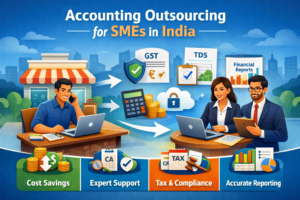
- Compliance with Tax and Regulatory Requirements
In India, tax laws and statutory regulations are frequently updated, from GST filings to TDS provisions and income tax returns. For SMEs, keeping pace with these changes can be both confusing and risky. Finance and accounting outsourcing firms bring deep subject knowledge and keep up with regulatory developments in real time. This ensures timely and accurate filings, preventing costly penalties and government scrutiny.
- Access to Advanced Tools and Technology
Modern financial management requires more than basic documents. It demands sophisticated software for invoicing, reconciliation, payroll, compliance tracking, and reporting. However, many SMEs hesitate to invest in these tools due to high costs and lack of internal expertise.
By working with accounting outsourcing companies, SMEs gain access to advanced platforms and automation tools without the burden of licensing or maintenance. This not only enhances efficiency but also ensures data is stored securely and available when needed.
- Reliable Financial Reporting for Better Decision-Making
Timely, accurate reporting is essential for sound decision-making, but many SMEs struggle to generate meaningful reports in-house. Outsourced accounting services provide customised financial statements, cash flow reports, budgeting tools, and profitability analysis, helping business owners make data-driven decisions.
Conclusion
Outsourcing for small and medium enterprises is no longer just a trend but a strategic necessity. By working with the right accounting outsourcing firm, SMEs in India can access high-quality expertise, reduce operational costs, and stay compliant with minimal stress. As competition increases and regulations become more demanding, investing in efficient finance and accounting systems today can give businesses the stability and insights to stay a step ahead of their competitors.
FAQs on accounting outsourcing for SMEs
1. Is accounting outsourcing good for small SMEs in India?
Yes. Even very small SMEs benefit because accounting outsourcing firms provide chartered accountant level expertise without full-time salary cost while ensuring GST, TDS, and ROC compliance.
2. How much can an SME save by outsourcing accounting?
Indian SMEs typically save 40–60% on finance costs by avoiding hiring, training, software licensing, and employee benefits.
3. Do outsourced accounting services help in GST compliance?
Absolutely. Accounting outsourcing companies manage reconciliation, ITC matching, and timely GST returns, reducing notice and penalty risk.
4. What tasks are handled by an accounting outsourcing firm?
Bookkeeping, payroll, vendor reconciliation, MIS reporting, GST/TDS returns, budgeting, audit preparation, and cash flow planning.
5. Is financial data safe with accounting outsourcing companies?
Professional firms use secure cloud tools, access controls, and NDAs to maintain high confidentiality and accuracy.
6. Can outsourcing accounting scale as my business grows?
Yes. Outsourced accounting services expand easily from 5 employees to 200+, multi-state GST, and investor-ready reporting without disruption.
7. Will outsourcing accounting reduce tax errors?
Yes. Accounting outsourcing firms follow automated checks and CA supervision that sharply lowers filing mistakes and compliance risk.